If you take care of commercial residential properties long enough, you learn the variation in between a resolution trouble as well as a sidewise movement trouble. Piece heaves, stair-step cracks, and hanging beam of lights tell one tale. Stooped cellar walls, pitching elevator arrows, as well as retaining structures sneaking towards a road inform an additional. Helical tieback anchors reside in that second story. They are the utility vehicle for avoiding sidewise lots where excavation is actually limited, soils are actually unstable, or speed as well as access constraints make traditional services impractical.
I knew this the hard way on a 1960s office complex along with a brick front view and also a cellar that available to a packing dock. The dock wall had been covered a loads times. Every wintertime the tuckpointing stopped working, and every springtime the wall surface leaned a bit extra. Excavating 10 feet deep alongside energies and an active alley was a nonstarter. Helical tieback anchors resolved it cleanly: marginal interruption, a predictable ability, and a guarantee I could possibly stand behind. Ever since, I try to find helical tiebacks whenever sidewise restraint is actually the governing issue during the course of industrial structure stabilization.
What a helical tieback anchor in fact does
Despite the title, a helical tieback is actually certainly not a pile in the vertical sense. Consider it as a steel tendon with helical platters that screws flat or at a superficial up angle right into proficient ground or even weathered rock, at that point receives locked off to a wall surface, delaying, or grade beam. The coils develop axial capability by means of end-bearing and also rubbing along bum rap. The "tieback" part is the stress occupied in between the anchor scalp and also the sustained structure.
Unlike grouted stone anchors that require drill-and-grout patterns and also treating opportunity, a helical tieback offers urgent bunch along with torque-to-capacity relationship. Along with adjusted installment, you validate ability as you go. That proof is a major factor these anchors have actually become a staple in commercial foundation repair and also structural foundation repair where schedules are tight.
Situations that call for helical tieback anchors
The clearest use scenarios discuss a design: lateral earth tensions or hydrostatic stress that go beyond a structure's protection, yet without space, finances, or even time for major digging or even cast-in-place countermeasures.
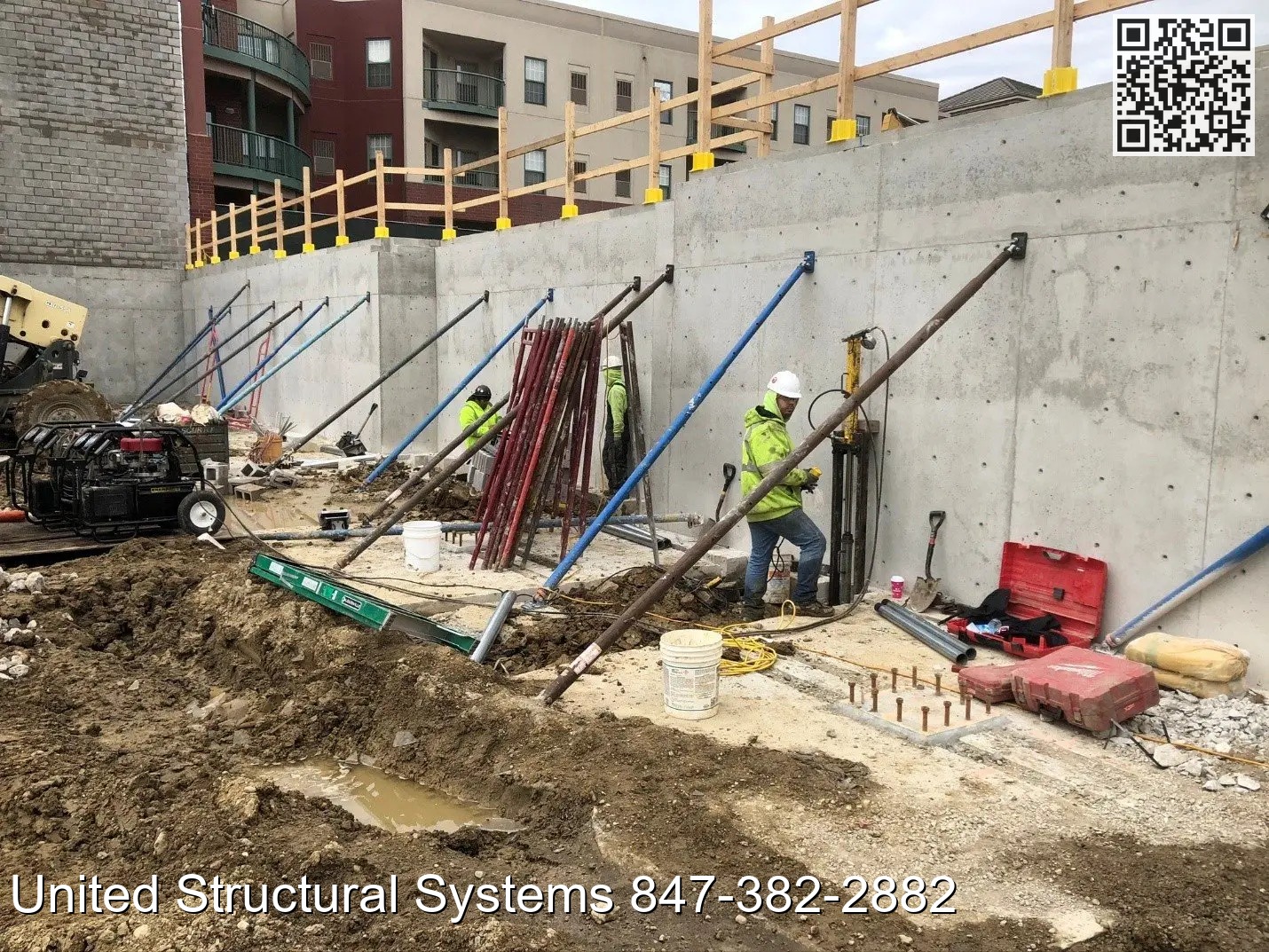
Retaining structures that can not sneak any kind of even further. Our team often set up helical tiebacks on preserving walls adjacent to social rights-of-way, parking decks, or even building pipes where excavation would shut down web traffic or go against easements. Tiebacks installed from the inside face of the wall surface fix this properly. Style typically targets planet tension at-rest or even active-plus-surcharge, along with necessary lots factors.
Basement as well as below-grade wall surfaces revealing inward variation. Inclined or trimmed CMU, fractured cast-in-place wall structures, as well as spandrel beam of light hardship indicate lateral overload, not negotiation. Helical tieback installment with wall structure cores, combined along with interior walers or platters, can easily maintain the wall structure and, in many cases, recoup a section of deflection.
Temporary shoring for excavations as well as additions. For business developments or energy corridors, helical tieback anchors pair with soldier piles or even piece piles to hold off cuts while foundations are actually set up. Contractors choose all of them because there is actually no cement healing delay, as well as a tiny workers with mobile devices can operate in cramping metropolitan lots.
Seawalls and also beachfront bulkheads. Lumber or even steel bulkheads shed segment eventually. Replacing deadman supports with helical anchors, typically angled to hit beneath stable upland grounds, repairs capability without destroying promenades or landscaping. Oxidation protection as well as appropriate hot-dip galvanizing become vital near saltwater.
Brick or stone façade stabilization over areaways and passages. In dense midtown hallways, spaces under pathways as well as superficial passages make complex excavation. Helical tiebacks may be cast to bypass the voids and also latch into capable strata, after that connected to a brand new lintel or even internal frame.
In each case, the market value hinges on setting in motion tension ability versus side forces while keeping disturbance low. That is actually different coming from commercial helical pile installation or even commercial resistance pile installation, which target upright bunch help. Helical tiebacks sustain wall structures and also digging units; helical piles and resistance heaps assist columns, pieces, as well as level beams.
When helical tiebacks are actually the inappropriate tool
They are actually not a panacea. Poor candidate ailments include really heavy cobble layers that decline seepage, substantial boulders, or even strongly harsh soils without a crafted rust strategy. If the wall surface is currently at the brink of failure along with crushed systems as well as insufficient birth control action, tiebacks alone may not save it; you might need to have to restore and also incorporate steel frames. Where resonance stipulations are actually excessive, also the small electricity from a drive electric motor may be a concern, although this is actually rare.
Where the concept needs remarkably high specific abilities, including solitary supports over 150 to 200 kips in strain, micropiles with case and grout bulb or bored rock anchors might be actually extra practical each capacity. For temporary shoring where decommissioning are going to be actually obligatory, soil nails or grouted anchors may outmatch in device cost, specifically on sizable repeated runs with simple access.
Reading the soil, not merely the drawings
Most specifications focus on noticeable the planet tension representations and also factored bunches. Those matter, yet success hangs on stratigraphy. Helical anchors need a seasoned bearing layer for the helixes. In soft clays, our experts upsize the helix diameter as well as raise the lot of layers, but the concept must still provide sufficient embedment beyond the active block. In sands, our company look for liquefaction ability and drain roads. In split profiles, it is common to bypass a silty joint as well as go for the thick sand at 18 to 25 feets for dependable twist correlation.
On a medical facility redesign in glacial till, our team predrilled pilot openings by means of a 6-foot cobble band to get to the dense source below. Predrill carries out certainly not neutralize capability if the coils still bite in to undisturbed material at the design depth, but it asks for cautious torque monitoring and, often, a revised Kt (the torque connection continuous) based on field proof tests.
How helical tiebacks match up to various other support as well as pile systems
Owners and designers typically talk to whether they need to use helical piles, protection heaps, micropiles, or tieback anchors. The answer moves coming from the bunch path as well as constructability constraints.
Commercial helical pile setup and also resistance pile setup address vertical weights and negotiation command. Helical piles, along with their helical platters, excel in clays and blended grounds, could be put in along with reduced sound and resonance, and deliver immediate capacity. Resistance stacks, or press stacks, establish capacity by jacking steel heaps against the structure, removing dirt instead of eliminating it. They work for underpinning when headroom is actually limited and when the existing establishment can function as a response to steer the piles.
Micropiles, commonly steel canvassing with grouted centers, sparkle in quite helical pier thick dirts or even rock, with high allowed lots and also flexibility for both tension and squeezing. Micropile installation calls for exploration, reinforcement, as well as grout curing, which improves time yet delivers strong functionality in challenging geology and also constricted websites. Micropiles can function as tiebacks with proper layout, commonly utilized when the required tension ability is beyond normal helical tieback ranges.
Helical tieback anchors being in the lateral bunch section. Where you need to have to pull back a wall surface or maintain a digging without massive tools, they give you verified, prompt stress ability along with marginal spoils. They can complement various other deep foundation repair techniques: a wall supported with tiebacks might sit atop a quality shaft sustained through helical piles, protection piles, or micropiles, each playing a distinct role.
The mechanics of design that concern in the field
The theoretical side knows: describe the active block, apply earth pressure coefficients, incorporate additional charges, consist of hydrostatic or seismic components, and then choose a tieback design as well as perspective. Virtual, a handful of details relocate the needle.
Embedment duration beyond the theoretical failing aircraft requires scope. We target eight to twelve feets past the degree in clay-based, sometimes extra in sand to reach heavy strata. The even farther the coils sit past the failing block, the less vulnerable they are to tiny helical piles foundation unitedstructuralsystems.com mistakes in ground parameters.
Helix arrangement is actually certainly not cosmetic. A two-helix support with 8 as well as 10 in plates acts in a different way than a three-helix with 10, 12, 14 inch layers. Layer space of 3 times the diameter decreases plate overlap in grounds and also enhances net capacity. In soft clay-baseds, bigger diameters along with wider space carry out much better, but drive twist rises and also set up equipment have to be actually sized accordingly.
Angle of installment as well as connection length positioning effect capability and efficiency. Steeper slants get to much deeper much faster yet might encounter internal obstacles. A flatter slant decreases head height inside the building but lengthens the support and also might require a longer region beyond the breakdown airplane. Balancing slant with site geometry is actually component fine art, part math.
Corrosion defense can not be a second thought. For irreversible commercial foundation stabilization, our team define hot-dip priming, enhanced propitiatory fullness, and at times a double-correlation method where expected reduction is actually measured over fifty to 75 years. In extremely threatening soils, utilizing epoxy-coated elements or even embedded rays along with grout-filled sleeves may be justified.
Load confirmation belongs on the essential path. Put in twist is actually a proxy, certainly not a warranty. Verification tests on at least 5 per-cent of supports, and functionality exams on selected sites, decrease risk. If motion under evidence tons exceeds requirements, firm up the concept prior to manufacturing continues.
Installation facts that split really good from great
Commercial helical tieback anchor setup unfolds practically similarly every single time, however the outcomes differ extensively depending on crew knowledge and the high quality of layout.
Access and targeting are the first restraints. Inside a basement, you often operate below ray of lights, around mechanicals, as well as with brickwork centers. We prepare core sites to stay clear of rebar or even connect light beams, utilize a scanning device to map steel, as well as established walers in front of teaching to regulate alignment.
Torque tracking should be actually disciplined. Make use of an adjusted digital torque monitor and log analyses at each feet of infiltration. A quick torque spike can easily signal a cobble; a plateau in sand might recommend slight failure around the shaft. The lead installer makes real-time telephone calls: back out somewhat, adjust speed, or even swap to a various helix arrangement if you are actually not achieving the anticipated twist at layout depth.
Grouting is certainly not consistently portion of helical anchor job, but some standards require post-grout to improve ability in coarse-grained grounds. When used, low-mobility grout pumped at the coil elevation may secure functionality. The give-and-take is time and also clean-up.
Head details are actually where visual appeals and also servicing intersect. On subjected interior walls, our experts make use of low-profile plates or incorporate the support head in to a steel waler painted to match. On exterior maintaining wall structures, our team intend to recess plates behind a new laminate or even capstone to keep the anchor components unseen as well as far from straight water exposure.
Coordination with other deep foundation repair trades issues. If the job additionally consists of commercial helical pile installation for brand new pillars or commercial micro pile installation under a slab, outlined the support fan trends to begin with to stay clear of clashes. It is actually less complicated to shift a stack location before exploration than to reroute a row of tiebacks that currently penetrate the wall.
A practical take a look at ability as well as movement
Owners at times expect absolutely no action under load. That is actually certainly not exactly how soil-structure systems behave. A helical tieback anchor possesses elastic prolongation under strain, plus minor seats of layers and also compressibility of the dirt mass. In a common cellar wall structure retrofit, anticipate a handful of millimeters of draw at proof weight, and also likely 1 to 3 millimeters much more in the course of lock-off as the wall surface begins to discuss weight. Those varieties are certainly not failings; they reflect physics.
If you are actually trying to draw a bowed wall surface back to plumb, be careful. Attracting also hard in round may break down brittle masonry or even shear supports at the head. We stage loads throughout support rows and screen split gauges. Often the best end result is actually stabilization at the existing line, along with cosmetics handled through epoxy injection or even stonework repairs. For foundation crack repair, tiebacks stop the cause of movement; they perform not "cure" splits. You still need to have to address water management, repointing, or epoxy and also carbon dioxide fiber where appropriate.
Permitting, powers, and also risk
Do not avoid power finds inside as well as outside. Even inside a basement, pipes may operate in wall structures as well as slabs. In older constructs, as-built sketches are actually positive fiction. A non-destructive browse and also a watchful captain opening technique spare problems. For outside tiebacks crossing characteristic product lines, safe and secure easements or utilize infringement agreements. Numerous legal systems treat tiebacks below social rights-of-way as encroachments that call for removable anchors or special permits.
Seismic zones bring additional examinations. Tiebacks could be part of an overall seismic fortifying bundle, but concept needs to think about cyclic payload results and prospective reduction of static tension during the course of drinking. In saturated sands, reduction of sidewise protection during the course of an event might justify much deeper embedment and unnecessary rows.
Cost as well as timetable expectations
Compared to drilled anchors, helical tiebacks often cut times off the routine due to the fact that there is actually no grout treatment opportunity just before tons testing and lock-off. In straightforward dirts, a two-person crew along with the appropriate travel scalp can mount numerous anchors daily, more if accessibility is excellent as well as embedment is shallow. Costs differ commonly by region and specification, however on commercial ventures the unit price properties favorably when ability demands reside in the 20 to 80 kip variation every support and web site coordinations are tight.
When ability requirements increase or grounds battle seepage, micropiles or even grouted anchors can easily mesmerize in cost-effectiveness. A mixed technique prevails: helical tiebacks where gain access to is precarious as well as lots are intermediate, micropiles where the loads are actually higher or even geology is difficult, and helical piles or protection piles for vertical help. That balance always keeps budget plans rational while fulfilling engineering criteria.
Case photos coming from the field
Parking garage keeping wall, downtown infill. The wall surface protruded 1.5 ins at midheight on the lowest degree. Excavation outside the home line was inconceivable. Our team cored at staggered altitudes, set up helical tiebacks at a 15 level upward slant to arrive at dense sand at 22 feet, as well as secured off to a steel waler spanning column to column. Verification examinations at 1.5 times design bunch maintained within 0.08 ins. The proprietor resumed gulfs within the week.
Bulkhead rehab at a harbour. Hardwood deadman supports were rotted in deep sea burst zones. Our experts used hot-dip galvanized helical anchors along with lengthy propitiatory thickness, mounted coming from the dock deck at a shallow angle to connect with upland soils. A continuous cap channel escalate lots. Regular torque spikes signified buried debris; our team readjusted paths as well as recorded twist extensively. The port gained yet another decade of company life along with marginal disturbance to tenants.
Historic basement along with stone debris walls. The wall structures had uneven faces and lime mortar. Tieback heads needed innovative bearing. We put in steel walers shimmed to the brickwork, firmed up in phases to prevent standing out stones, and also included internal steel posts under shafts supported by helical piles. The mixture of helical tiebacks and helical piles gave the proprietor both lateral as well as upright stabilization without invasive excavation.
Integrating tiebacks in to an extensive fixing plan
A successful commercial foundation stabilization planning appears beyond one item. Lateral restriction coming from tiebacks sets naturally along with water drainage renovations to decrease hydrostatic tension. Water is relentless: if your wall sees groundwater, include boundary drains, sump redundancy, and basement waterproofing membrane layers. Inside, address building continuity. A tieback fastened in to a broken wall surface without waler or even diaphragm assistance can easily center worry and also cause weak failure.
For jobs along with resolution as well as lateral issues, make use of the right mix. A quality shaft assisted through helical piles or even protection stacks handles vertical tons and avoids further settlement deal. Helical tiebacks take care of side tension. If bunches exceed common helical varieties or even geography controls, integrate micropiles or even grouted anchors. The objective is not to champion one innovation, but to fulfill the structure's needs along with a worked with system.
Practical to-do list for deciding on helical tiebacks
- The driving concern is actually sidewise activity, certainly not vertical resolution, and also digging is actually constrained through utilities, building lines, or even social access. Subsurface investigation determines a competent bearing coating reachable along with coils at affordable torque, past the active failing plane. Required load per support match within common helical tieback capability varies for available tools and also staff skills. The task profit from prompt lots verification and also accelerated timetable contrasted to grouted systems. Corrosion problems are comprehended, and also the layout features suitable security for the desired solution life.
A word on manufacturer's warranties as well as documentation
Owners care about promises. Provide warranties you can easily recognize by managing variables. Adjust twist equipment, document setup records, keep verification examination documents, and photograph head particulars just before they fade away responsible for coatings. Where anchors cross right into public or even neighboring property, always keep signed easements along with the job file. For structural foundation repair, that record often ends up being as useful as the steel itself when the structure adjustments hands.
Where foundation crack repair fits
Tiebacks carry out certainly not close gaps, but they stop the load that caused them. After stabilization, epoxy treatment may restore big behavior in cement wall structures if gaps are dry out and well-maintained. In stonework, sewing along with helical bars set in cement, blended with repointing, provides constancy. When cracks are actually driven by hydrostatic tension, include internal water drainage as well as exterior water-proofing where possible. It prevails to organize this series: support along with tiebacks, handle water, at that point repair cracks. That order lowers the possibility of re-cracking.
Final ideas from the field
If the project asks you to keep back dirt, water, or a framework that prefer to relocate laterally, helical tieback anchors are worthy of a very early appeal. They deliver expected ability, speed, and also a little jobsite impact. They combine effectively with other aspects of deep foundation repair, featuring helical piles, protection heaps, and also micropiles, each packing its lane. Their limitations are actually as necessary as their toughness: geology, rust, and also capacity objectives have to align. When they perform, the result is actually wearing out in the best method, a wall surface that stays and also a customer who forgets you were actually ever before there.
 Ask ChatGPT
 Ask Grok
 Ask Perplexity
 Ask Claude
 Ask Google AI
 Ask You